 EN
EN
 INA
INA
Participation of Udayana University Archaeology Students and Lecturers in a Traveling Workshop on Museums and Cultural Heritage Sites in Sumbawa, West Nusa Tenggara
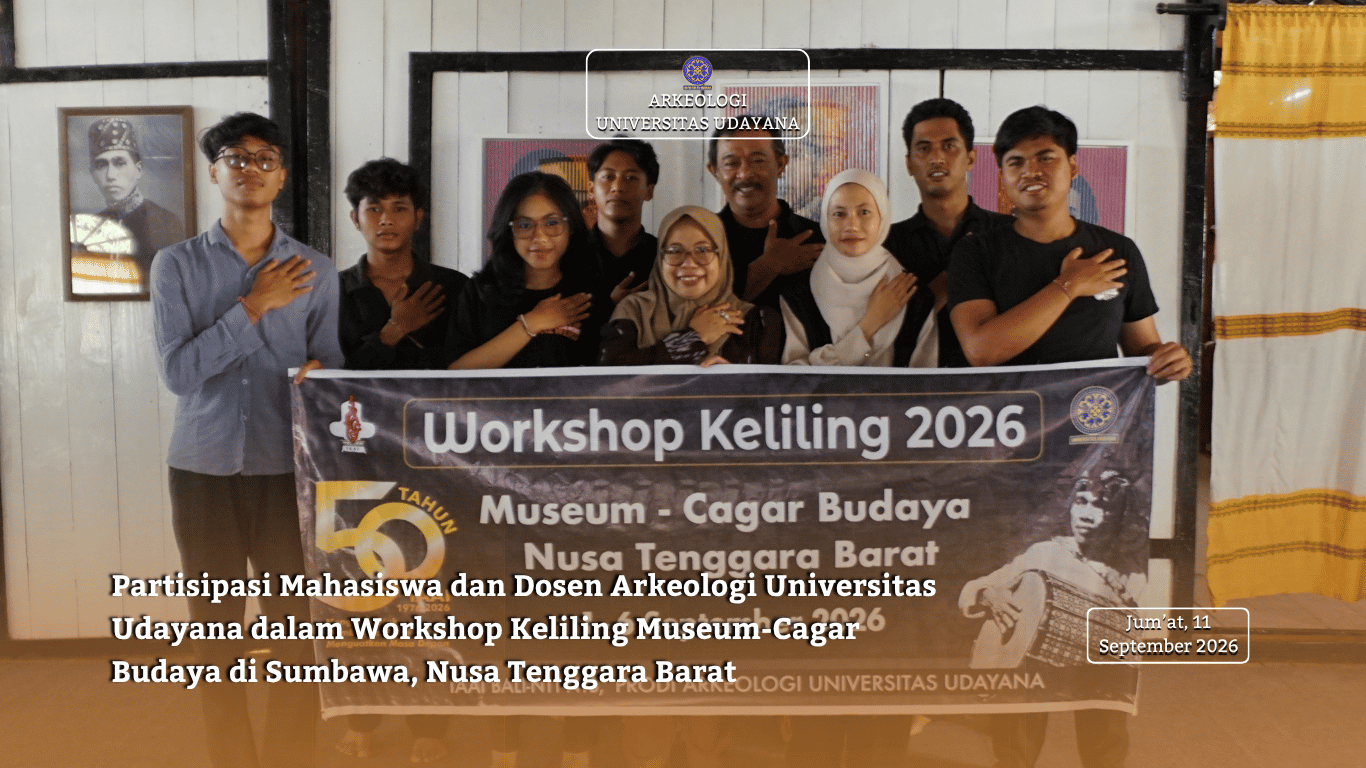
Denpasar, September 11, 2026 – From September 1–6, 2026, a Traveling Workshop and Archaeological Research Mentoring Program was held in Sumbawa, West Nusa Tenggara. The activity aimed to educate the public and raise awareness about the significance of cultural heritage sites and artifacts.
The event involved Mr. Kristiawan, S.S., M.A., who served as both a mentor and researcher, guiding the event, as well as archaeology students from Udayana University who assisted with the research process and field activities. The event was also conducted in collaboration with site managers and relevant agencies involved in site management and the implementation of the activities. Furthermore, the primary target audience for this event was the local community, who play an important role in raising awareness and understanding the significance of cultural heritage sites.
The activity was carried out through several stages, including field observation, documentation and recording of the conditions of sites and artifacts, discussions, research assistance, as well as a traveling workshop on the existence and importance of preserving archaeological remains, which served as the main part of the activity.
The traveling workshop was organized to enhance public understanding and awareness of the importance and preservation of cultural heritage sites, to introduce the results and processes of archaeological research to the public, to encourage community involvement in cultural heritage preservation efforts, and to connect academic activities with the needs and conditions of local communities. This activity also served as a means of sharing archaeological knowledge with the community.
One of the locations featured in the program was the Bala Datu Ranga Museum in Sumbawa, West Nusa Tenggara. Discussions focused on the significance of the museum, the site, and the artifacts within it from historical, cultural, scientific, and educational perspectives. Through these activities, participants gained an understanding that artifacts are not merely objects in a collection but also sources of information about the lives, cultures, and historical journeys of past communities.
The selection of the Bala Datu Ranga Museum as the focus of the discussion also provided an opportunity to explore how cultural heritage can be communicated to the public through museums. Thus, the workshop not only addressed the physical aspects of the artifacts but also how the values and meanings they embody can be understood, conveyed, and utilized as an educational tool for the public.
The activity was conducted because cultural heritage sites and artifacts are not only valuable as historical objects or places, but also hold historical, scientific, educational, cultural, and social value, as well as significance for community identity. Public outreach is necessary so that the community can understand that archaeological remains are a source of information about human life in the past. It is hoped that this understanding will foster public awareness regarding the existence and preservation of cultural heritage.
For students, this activity serves as a means to gain direct experience in conducting field research while also understanding how the results of archaeological research can be communicated to the public. This activity also teaches students that archaeology is not only about researching and studying the remnants of the past but also plays a role in the preservation, education, and utilization of cultural heritage for the community.
Through this activity, it is hoped that the community will become aware of the existence and significance of sites and artifacts in their area, develop an awareness of the importance of preserving cultural heritage sites, and become involved in efforts to preserve cultural heritage. This activity is also expected to yield preliminary data on the condition of the sites and artifacts and provide students with experience in field-based archaeological research.
This traveling workshop in Sumbawa is an initiative that combines the aspects of “research, education, and cultural heritage preservation.” Through the guidance of lecturers and the involvement of archaeology students, the activity not only provided research experience and data, but also served as a platform to introduce the significance of the sites and artifacts to the community. This approach is crucial because the success of cultural heritage preservation is closely tied to the level of understanding, concern, and engagement of the communities surrounding the sites.
FACULTY OF HUMANITIES