 EN
EN
 INA
INA
Two Archaeology Students of Udayana University Join Vaivasvata Research on Ancient Ornamental Gravestones in Lombok
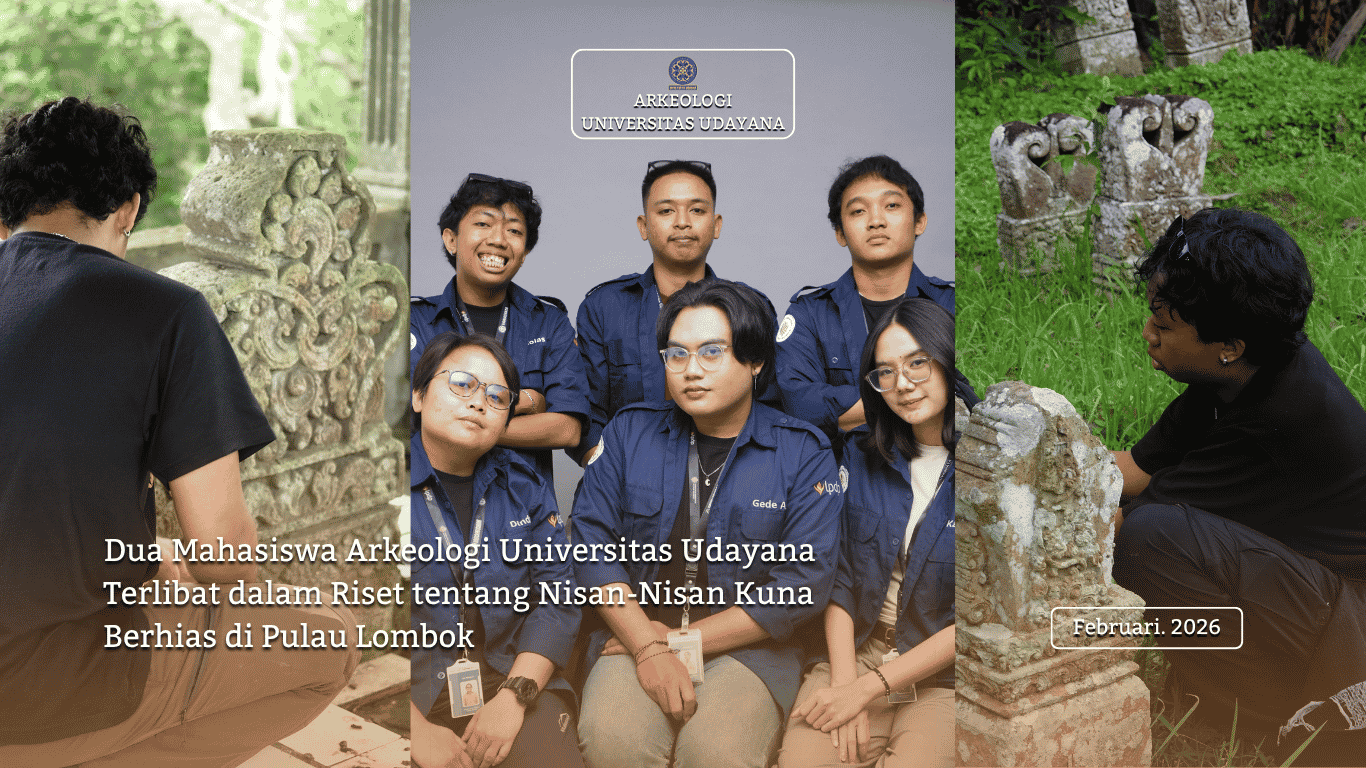
Lombok, Februari 2026 — Two students of the Archaeology Study Program, Faculty of Humanities, Udayana University, Nicolas Nesta Rama Umbu Lado (Class of 2023) and Lalu Sunandy Teguh Drayanata (Class of 2024), participated as members of the Vaivasvata Research Team in a study entitled “Dokumentasi dan Katalogisasi Nisan Kuna Berhias di Pulau Lombok, Nusa Tenggara Barat: Cerminan Interaksi dan Akulturasi Budaya di Gumi Sasak”. The research was conducted from 5–22 February 2026 as part of an inter-university collaboration involving students from the University of Indonesia, Hasanuddin University, and Udayana University.
The research received funding through the “Program Layanan Lainnya Kategori Kajian Objek Pemajuan Kebudayaan dan Cagar Budaya dalam lingkup Program Pemanfaatan Hasil Kelola Dana Abadi Kebudayaan Tahun 2025” (DanaIndonesiana 2025). The team was led by Lalu M. Balia Farsahin, S.Hum., M.Si., from the Department of Anthropology, University of Indonesia, with Muh. Nur Rahmat Yasim, S.Sos., M.Si. (Department of Anthropology, Hasanuddin University), Adinda Tasya Namira, S.Hum. (Department of Archaeology, University of Indonesia), and Katya Sekarani, S.Li. (Department of Anthropology, University of Indonesia) as other team members. Nicolas and Teguh were the two students from the Archaeology Study Program, Udayana University, involved as members of the research team.
Fieldwork covered 37 burial sites across West, Central, East, and North Lombok. Activities included documentation, measurements, attribute recording, and gravestone cataloguing, with particular attention to their historical distribution, typology, morphology, and cultural context.
Nicolas had been involved since the preliminary survey, while Teguh joined during the main data-collection stage. Both contributed to documentation, measurements, attribute recording, and catalogue entry. Nicolas also contributed to site mapping, burial-site inventory, database development, and the preparation of a book manuscript and scientific articles. All sites within the research scope were successfully documented, resulting in 170 gravestone samples included in the research catalogue. The catalogue is currently being prepared for publication and dissemination, while the research database has been developed as part of the project's data management.
Archaeological research was complemented by an ethnographic study of death practices through interviews with community and customary figures in Karang Panasan and Bayan Timur, including village heads, Toaq Lokaq, Pemangku, Romo Pandita, and customary leaders. The ethnographic component examined the relationship between graves and gravestones and Sasak practices and concepts of death in Boda, Wetu Telu, and Wetu Lima contexts. The research activities also included a workshop entitled “Nisan sebagai Teks Budaya: Tipologi Arkeologis dan Etnografi Multi-situs dalam Melihat Kematian” (Gravestones as Cultural Texts: Archaeological Typology and Multisite Ethnography in Understanding Death), featuring Lalu M. Balia Farsahin and Muh. Nur Rahmat Yasim as speakers.
For Nicolas, the research provided an opportunity to apply the knowledge gained through the Archaeology Study Program at FIB Unud in an actual research setting.
“This experience allowed me to apply what I have learned in the Archaeology Study Program at FIB Unud, from field documentation and measurements to database management and the preparation of publication materials.”
Teguh highlighted the practical experience gained through archaeological fieldwork and community engagement.
“I gained direct experience in documenting, measuring, and recording gravestones. Interactions with local communities also showed me that graves and gravestones are not merely archaeological objects, but are closely connected to local knowledge and cultural practices.”
The participation of the two students reflects the opportunities available to Archaeology students at FIB Universitas Udayana to develop their academic and practical competencies through interdisciplinary and inter-university research. Their experience covered fieldwork, archaeological documentation, data management, community engagement, and academic writing. The research outputs will be further developed through catalogue publication, dissemination, and scientific publications, contributing to the documentation and study of the history, archaeology, and cultural heritage of Sasak communities in Lombok.
FACULTY OF HUMANITIES