 EN
EN
 INA
INA
Beyond Fieldwork: Udayana Archaeology Students Contribute to Research Dissemination in Lombok
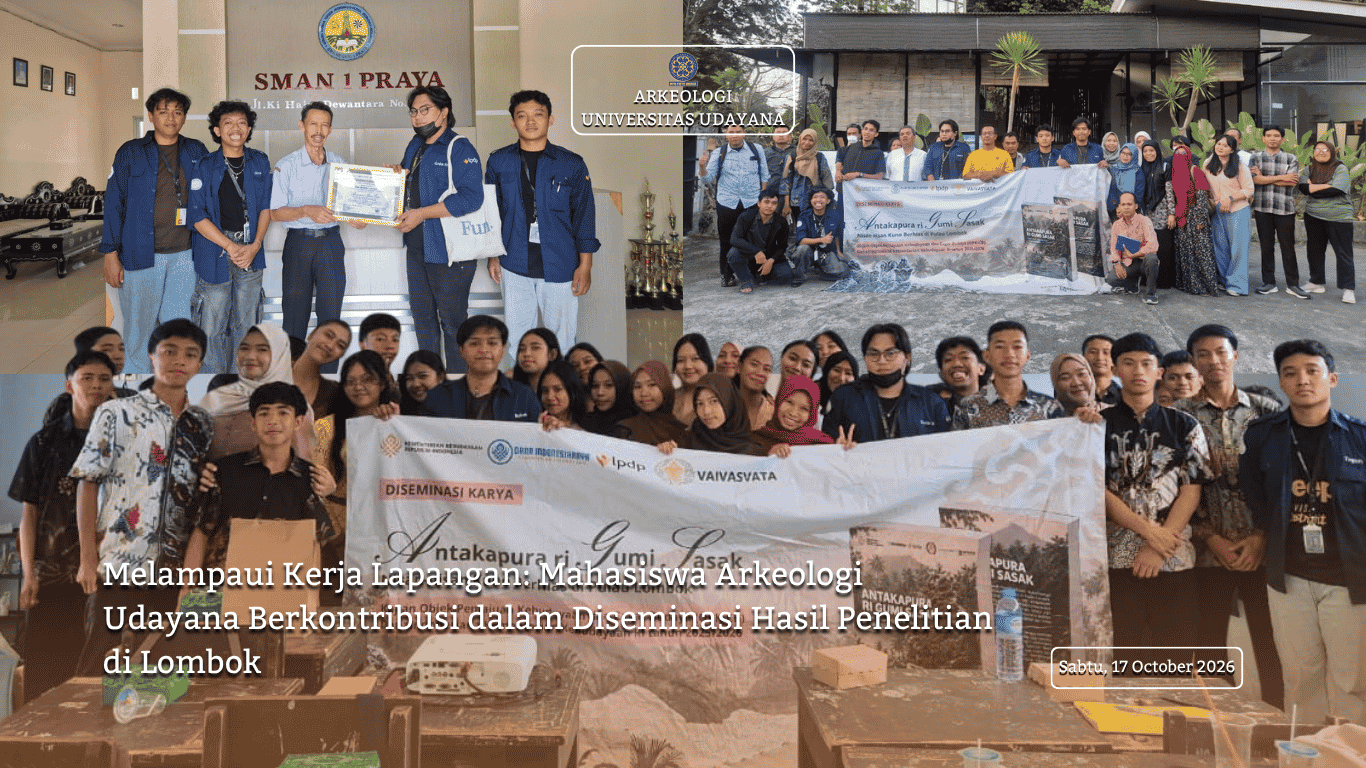
Lombok,
17 October 2026 —
Two students from the Archaeology Study Program, Faculty of Humanities, Udayana
University, Nicolas Nesta Rama Umbu Lado and Lalu Sunandy Teguh Drayanata,
contributed to the dissemination of research findings by the Vaivasvata
Research Team across Lombok on 14–15 October 2026. Their contributions included
event planning and coordination, presentation preparation, publication,
technical coordination, and documentation, supporting efforts to make
archaeological knowledge more accessible to the public.
The
dissemination activities took place at SMAN 1 Praya in Central Lombok and
Gairah Kopi in East Lombok on 14 October, followed by SMAN 1 Tanjung in North
Lombok and the Rinjani Geopark Office in Mataram on 15 October 2026. The events
brought together high school students, history enthusiasts, lecturers,
researchers, journalists, and members of history-focused communities.
Nicolas,
a member of the Class of 2023, was involved in preparing presentation materials
and managing publications related to the activities. Teguh, from the Class of
2024, handled technical coordination and documentation. Both students also
participated in planning and coordinating the events, contributing to the
delivery of research findings to audiences with diverse backgrounds.
“Research does not end when data
collection and analysis are completed. Its findings need to be communicated to
the public so that they can be understood and become a starting point for
further discussion. Through this dissemination, I learned that communicating
research requires different approaches depending on the audience, without
compromising the academic rigour behind the findings,” Nicolas said.
For
Nicolas, the experience highlighted the importance of science communication as
an integral part of academic work. Preparing presentation materials and
publications was not merely a supporting task, but also a way of bridging
research findings and the wider public.
Teguh,
meanwhile, emphasised the importance of coordination and technical preparation
when organising activities across multiple venues. His responsibilities in
technical coordination and documentation provided an opportunity to understand
the organisational aspects of academic research that are not always visible
during fieldwork.
“This experience showed me that
the success of a research activity also depends on the work behind the scenes.
Coordination, technical preparation, and documentation are essential to
ensuring that research findings can be communicated effectively. Interacting
with participants from different backgrounds also demonstrated that archaeology
offers opportunities for meaningful conversations with the public,” Teguh
said.
The
dissemination featured Lalu M. Balia Farsahin, S.Hum., M.Si. (Department of
Anthropology, University of Indonesia), and Muh. Nur Rahmat Yasim, S.Sos.,
M.Si. (Department of Anthropology, Hasanuddin University). Their presentations
explored decorated ancient gravestones as sources of information about cultural
interaction, identity, social status, and the dynamics of death-related
traditions among the Sasak people.
The
research demonstrates that decorated gravestones are not merely material
remains but also preserve evidence of relationships between communities and
broader cultural transformations. Studies of funerary practices and burial
ornaments also provide opportunities to examine how social status and identity
were expressed through mortuary traditions in Lombok.
By
presenting these findings through public dissemination activities, the team
introduced archaeological and ethnographic research to audiences beyond
academic institutions. The participation of high school students and
history-focused communities also created opportunities to discuss cultural
heritage through research grounded in evidence, documentation, and social
context.
Before
participating in the dissemination activities, Nicolas and Teguh had taken part
in the Vaivasvata Research Team’s fieldwork in February 2026. This
inter-university research project involved documenting, measuring, recording
attributes, and cataloguing gravestones at burial sites across Lombok. Nicolas
participated from the preliminary survey stage, contributing to site mapping,
database development, and the preparation of research publications, while Teguh
joined during the main data-collection phase.
Their
fieldwork experience provided a foundation for their subsequent involvement in
research dissemination. Through these activities, the students gained
experience connecting archaeological research with academic material
preparation, event coordination, publication, and public communication. These
competencies are relevant to their academic development and future work in
archaeology and cultural heritage management.
The
Vaivasvata Research Team’s activities also included ethnographic fieldwork in
several parts of Lombok. From 7 to 11 October 2026, the team collected
ethnographic data in Bayan, North Lombok, and participated directly in the
implementation of a local mass circumcision tradition. Following the
dissemination events, the team continued its ethnographic research on the Boda
community on 16 October in Tendaun and Ganjar, Mareje Timur, West Lombok.
Further data collection took place in the Terara area of East Lombok on 17
October.
These
activities brought together archaeological investigations of material remains
and ethnographic approaches to living cultural practices. By examining
different forms of evidence, the research seeks to develop a broader
understanding of Lombok’s history and cultural dynamics while considering the
social contexts of the communities involved.
The
students’ participation was supported by the Archaeology Study Program at
Udayana University, which granted academic leave permission for their
involvement in the research activities. This support provided opportunities for
the students to develop their competencies through field research and public
dissemination beyond the university campus, while contributing to
inter-university academic collaboration.
The
Vaivasvata Research Team’s project received funding through the 2025
DanaIndonesiana programme, under the category “Program Layanan Lainnya
Kategori Kajian Objek Pemajuan Kebudayaan dan Cagar Budaya dalam lingkup
Program Pemanfaatan Hasil Kelola Dana Abadi Kebudayaan Tahun 2025”,
supported by Indonesia’s Ministry of Culture (Kementerian Kebudayaan Republik
Indonesia) and the Education Fund Management Institution (LPDP).
The
involvement of Nicolas Nesta Rama Umbu Lado and Lalu Sunandy Teguh Drayanata
demonstrates that student contributions to archaeological research extend
beyond field data collection. Through planning, publication, technical
coordination, documentation, and dissemination, students can participate in the
broader process of making research accessible to society. These experiences
support their academic development while helping expand public access to
knowledge about Lombok’s history and cultural heritage.
This
experience also reflects the important role of the Archaeology Study Program at
Udayana University in fostering students’ academic growth and professional
development. By supporting student participation in research and public
engagement beyond the classroom, the programme helps cultivate a generation of
archaeologists equipped not only with research skills, but also with the
ability to communicate knowledge and contribute meaningfully to the
preservation and promotion of Indonesia’s cultural heritage.
FACULTY OF HUMANITIES