 EN
EN
 INA
INA
The Archaeology Program Holds a Public Lecture on the Theme “Reading Indonesia’s Past Through Inscriptions: Traces of Indonesian Epigraphy”
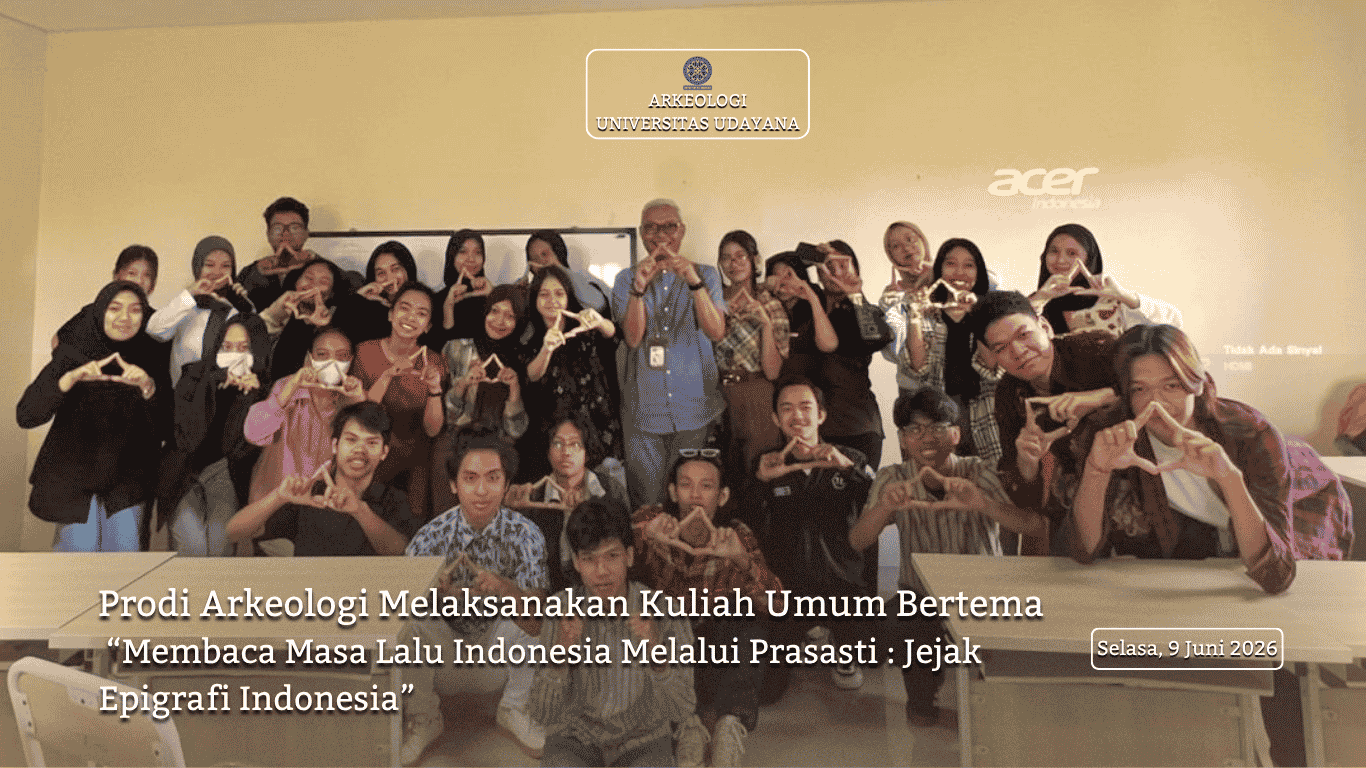
Jimbaran, June 9, 2026 - The Archaeology Program of
the Faculty of Humanities, Udayana University, held a public lecture on the
topic “Reading Indonesia’s Past Through Inscriptions: Traces of Indonesian
Epigraphy,” which took place at the Faculty of Humanities Campus in Jimbaran on
Tuesday, June 9, 2026. The event was attended by students from the 2025 class
of the Archaeology Program. The public lecture was organized to provide an
understanding of the importance of epigraphic studies in uncovering Indonesia’s
history through inscriptions.
The public lecture featured Dr. Wahyu Rizky Andhifani,
S.S., M.M., as the speaker. He is a junior expert researcher at the BRIN Center
for Prehistoric and Historical Archaeology Research and serves as the Chairman
of the Indonesian Association of Epigraphers (PAEI). During his presentation,
Dr. Wahyu emphasized the crucial role of an epigraphist in reconstructing
history, as inscriptions serve as the primary source of historical information.
As an epigraphist, he noted, there are many challenges in reading and
understanding the meaning of an inscription.
In interpreting an inscription, Dr. Wahyu outlined
several key steps: Documentation, Reading, Transliteration, Translation, and
Interpretation. Among these processes, transliteration is the most critical
step in deciphering the inscription’s content. Through this public lecture, Dr.
Wahyu expressed his hope that future generations will develop an interest in
and join the field of epigraphy.
The public lecture was conducted interactively,
featuring a question-and-answer session and discussions with the students.
Several students engaged in in-depth discussions with Mr. Wahyu regarding
various inscriptions and their contents. The discussion
concluded with an interesting discussion regarding the curses mentioned in
certain inscriptions and the ongoing debates surrounding their authenticity and
interpretation.
Through this public lecture, students are expected to
become more motivated to study epigraphy as an important field of archaeology.
It is also hoped that more young scholars will pursue careers as epigraphers
and contribute to the advancement of epigraphic studies in Indonesia.
FACULTY OF HUMANITIES