 EN
EN
 INA
INA
PATI 2026: Student Collaboration in Archaeological Research, Conservation, and Museology at the Manyarejo Archaeological Site
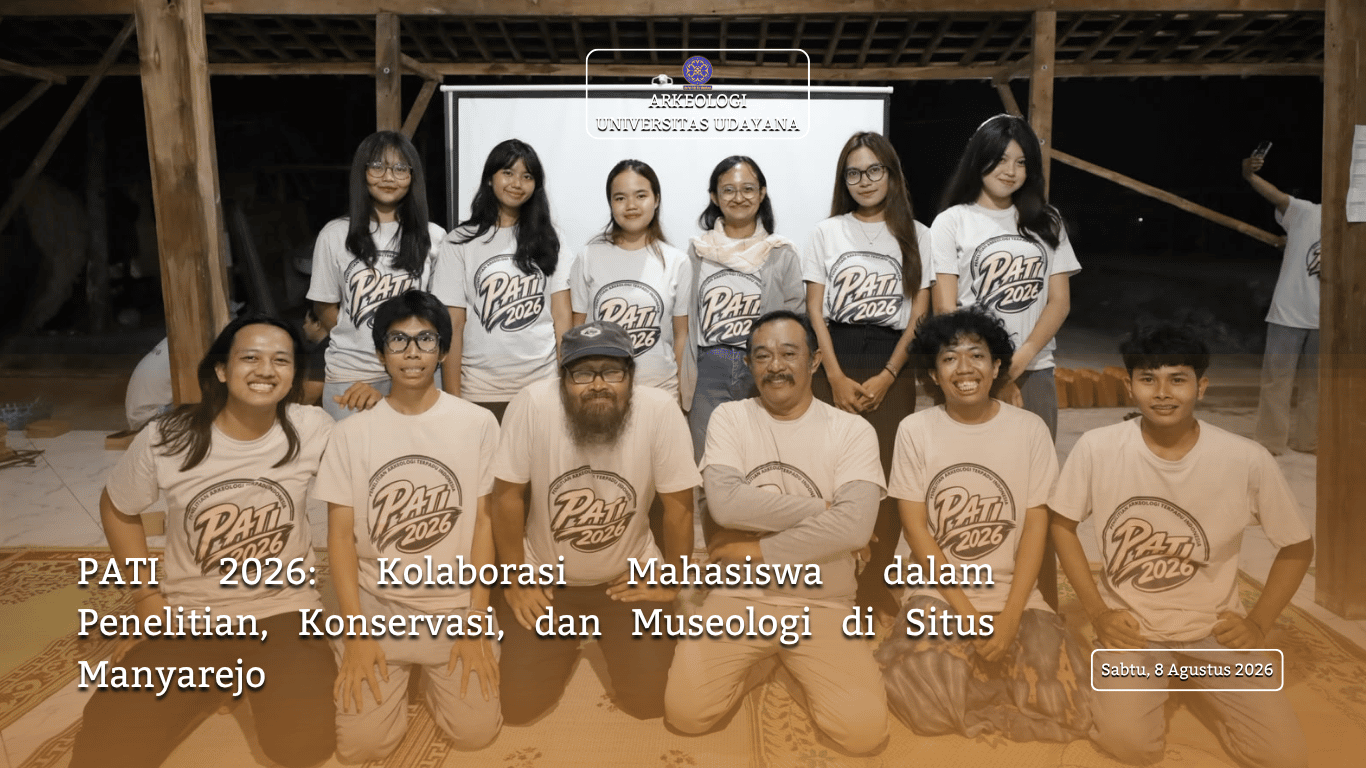
Sragen, August 8, 2026 – The 2026 Penelitian Arkeologi Terpadu Indonesia (PATI) project, perceived as a collaborative and integrated archaeological research held at the Manyarejo Site, Sangiran, from July 27th to August 8th, officially concluded today. The activity involved students from six universities in Indonesia and was conducted in collaboration with the National Research and Innovation Agency (BRIN) and the Arsari Djojohadikusumo Foundation (YAD). PATI 2026 consisted of three main teams: the Excavation Team, Conservation Team, and Museology Team.
During the program, the Excavation Team carried out field research and documentation activities at the Manyarejo Site. These activities included cleaning excavation trenches, conducting mapping, including topographic maps, general maps, databases, and coordinate points, producing photogrammetric documentation, and reanalyzing the stratigraphy and artifacts. The activities were carried out to systematically document the condition of the site and produce spatial and visual data to support further archaeological research.
Meanwhile, the Conservation Team conducted evaluation and conservation activities on archaeological remains from previous PATI activities as well as newly discovered finds. One of the main activities was evaluating the conservation results from PATI 2023, 2024, and 2025. In addition, the team carried out conservation on newly discovered finds at the Mpu Balung houses, excavation trenches, and archaeological remains that were still located on the site.
The conservation activities emphasized environmentally friendly methods using organic materials (green conservation). The techniques used included lime juice for wet cleaning of fossils, essential oil nanoemulsion to prevent the growth of microorganisms on fossils, and the use of anchors and gelatin to join fragmented fossils. All Conservation Team activities were conducted under the supervision of museum conservators, including fossil intervention, evaluation of fossils conserved during PATI 2023, 2024, and 2025, and the classification of findings from the Mpu Balung houses. These practices formed part of the application of green conservation principles in the preservation of archaeological remains at the Manyarejo Site.
The Museology Team focused on developing a concept for a community-based on-site museum at the Manyarejo Site. The planning considered how archaeological remains could be presented and interpreted to the public while maintaining the connection between the site, cultural heritage, and the surrounding community.
Throughout the program, students from the six participating universities worked collaboratively across the three teams. PATI 2026 served as an integrated learning environment, providing participants with direct experience in archaeological research, conservation, and museology while encouraging the exchange of knowledge and experiences among students.
Overall, PATI 2026 served as the final phase of the PATI project at
Sangiran, which was conducted since 2023. Next year, the PATI project is
supposed to move on to another potential archeological site in Indonesia. Thus,
PATI 2026 strengthened its role as a platform for
academic collaboration, research, and archaeological heritage preservation.
Through excavation activities, environmentally conscious conservation
practices, and the development of a community-based museum concept, the program
is expected to contribute to the sustainable preservation of the archaeological
heritage of the Manyarejo Site, Sangiran.
FACULTY OF HUMANITIES