 EN
EN
 INA
INA
International Collaboration at Liang Bua: Udayana University Students Gain Hands-on Archaeological Research Experience
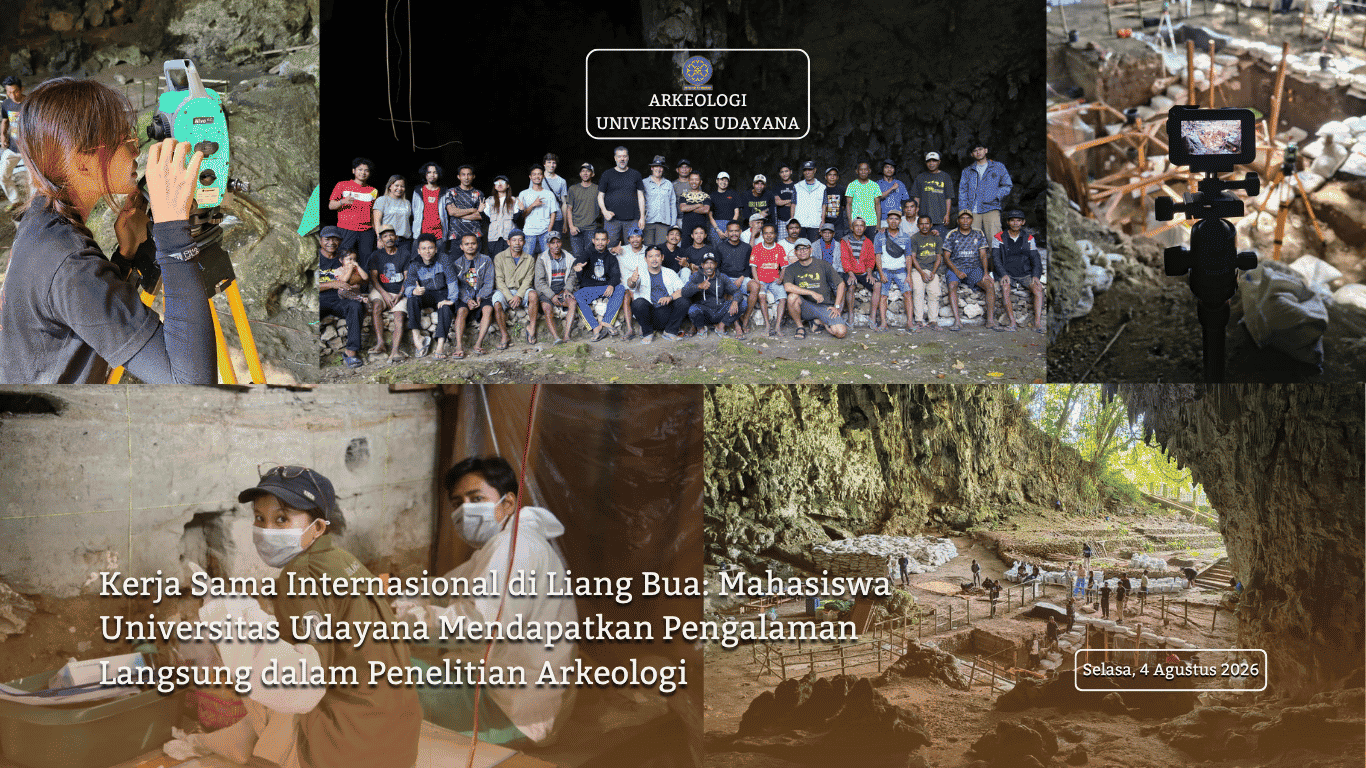
Denpasar - Every year, the Liang Bua archaeological site in Flores, East Nusa Tenggara, becomes a meeting point for researchers from around the world seeking to uncover new evidence about human evolution and prehistoric life in Wallacea. Recognized internationally as the discovery site of Homo floresiensis, Liang Bua continues to serve as one of Southeast Asia's most important archaeological research locations, attracting multidisciplinary scientific collaboration and advanced field investigations.
For
the 2026 research season, conducted from 29
May to 29 July 2026, I Made Agus Julianto, S.S., M.Sc., a lecturer and
researcher from the Archaeology Study Program, Faculty of Humanities, Udayana
University, participated in the excavation together with two Archaeology
students, Valentha Joe
Trisnadjati and Devina Anggeraini. Their involvement represents
Udayana University's continued participation in the annual international
research and scientific collaboration
program at Liang Bua.
The research is organized by the National Research and Innovation Agency (BRIN) in collaboration with Lakehead University (Canada), the University of Wollongong and Macquarie University (Australia), and the Max Planck Institute (Germany). The 2026 field season also brought together five archaeology students from three Indonesian universities (two from Udayana University, one from Gadjah Mada University, and two from the University of Indonesia). This collaboration created an environment where participants could exchange knowledge and field experiences, fostering academic connections not only with international researchers but also among Indonesia's leading archaeology programs.
The project also integrates expertise from multiple scientific disciplines, including Archaeology, Molecular Biology, Ancient DNA, Evolutionary Genetics, Paleoanthropology, and Geochronology, allowing researchers to reconstruct the biological, cultural, and environmental history of Liang Bua through an interdisciplinary approach.
During the excavation season, Valentha Joe Trisnadjati and Devina Anggeraini served as Excavation Box Supervisors, overseeing the daily excavation process within their assigned excavation units. Their responsibilities included monitoring archaeological and geological changes revealed in each excavated layer, ensuring that excavation procedures were carried out systematically, coordinating excavation activities with trained local workers, and maintaining accurate field documentation throughout the project.
In addition to their supervisory role, both students regularly participated directly in the excavation process by working inside the excavation units. They documented each completed excavation spit, recorded stratigraphic profiles and archaeological contexts, labelled and catalogued recovered materials, and assisted in the digitization of daily excavation records. They also gained hands-on experience operating the Total Station to produce high-precision three-dimensional spatial documentation of archaeological findings.
Working alongside an international team of archaeologists and specialists from diverse scientific disciplines provided valuable opportunities to learn about a wide range of analytical methods, including ancient DNA research, evolutionary genetics, geochronological dating, and paleoanthropological analysis. Through daily collaboration and scientific discussions, the students gained first-hand insight into how multidisciplinary research contributes to understanding the evolutionary history of humans and the formation of archaeological deposits at Liang Bua.
For
Valentha Joe Trisnadjati and Devina Anggeraini, participating in the Liang Bua
research project was an invaluable academic experience. Beyond strengthening
their technical skills in excavation, archaeological recording, and field
documentation, the program provided opportunities to collaborate with fellow
archaeology students from the University
of Indonesia and Gadjah
Mada University, creating a dynamic environment for sharing
perspectives, discussing archaeological methods, and learning from one another.
At the same time, working alongside internationally recognized researchers
broadened their understanding of multidisciplinary archaeological research and
strengthened their professional networks. Their participation reflects Udayana
University's continued commitment to preparing students for collaborative
research at both the national and international levels.
FACULTY OF HUMANITIES