 EN
EN
 INA
INA
Archaeology Study Program Participates in the 4th National Epigraphy Seminar
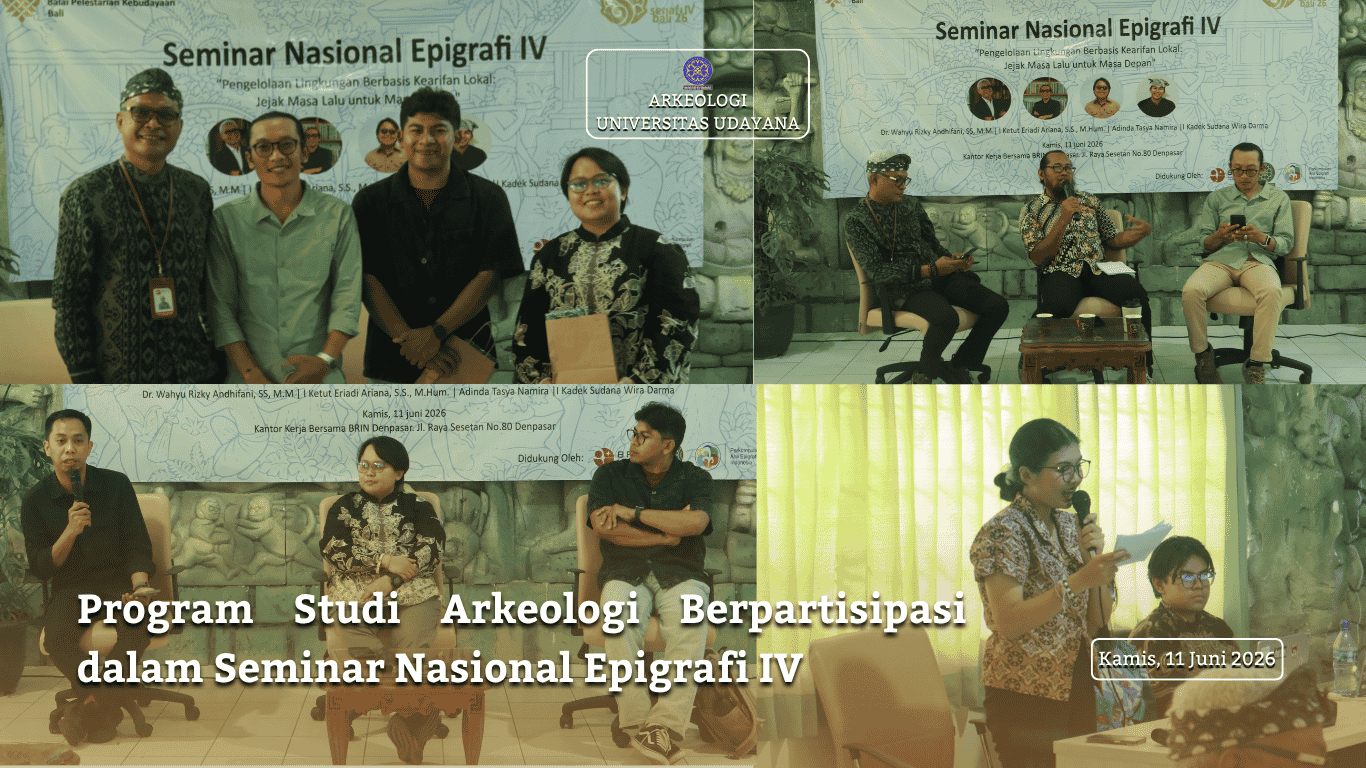
Denpasar, June 11, 2026 - The Archaeology Program participated in the 4th National Epigraphy Seminar held on Thursday, June 11, 2026, at the BRIN Joint Office in Denpasar. The seminar carried the theme “Environmental Management Based on Local Wisdom: Traces of the Past for the Future.”
The 4th National Epigraphy Seminar was organized by the Indonesian Association of Epigraphers Experts (PAEI), chaired by Luh Suwita Utami, S.S., M.Si., in collaboration with the Bali Regional Cultural Preservation Center, the National Research and Innovation Agency (BRIN), and Udayana University. The event was officially opened by the Head of the Bali Regional Cultural Preservation Office. The event aimed to explore and discuss the information contained in inscriptions regarding the relationship between humans and the environment in the past, while also understanding the ecological values and local wisdom recorded within them as an effort to support environmental conservation and cultural advancement in the present.
The seminar consisted of two sessions featuring four speakers. In the first session, Dr. Wahyu Rizky Andhifani, S.S., M.M., presented a paper titled “Recording the Past, Interpreting the Future: The Role of Epigraphy as a Primary Source of Indonesian History.” The second speaker, I K. Eriadi Ariana, S.S., M.Hum., presented a paper titled “Narratives of Environmental Management in the Lake Batur Area: A Comparison of Inscription Data with the Rajapurana of Pura Ulun Danu Batur.” The first session was led by a lecturer from the Archaeology Study Program, Rochtri Agung Bawono, S.S., M.Si., who served as the moderator.
In the second session, Adinda Tasya Namira, S.Hum., presented the topic “Traces of Environmental Utilization and Management in Coastal Areas in Ancient Balinese Inscriptions from the 9th–12th Centuries CE.” Next, I Kadek Sudana Wira Darma, S.S., M.Si., presented on “Inscriptions on Statues Around Pejeng: A Re-examination of Paleography and Iconography.” This session was moderated by Dr. Abu Muslim, M.Hi. After all the presentations were completed, the event continued with a discussion and Q&A session, providing participants with the opportunity to engage in direct dialogue with the speakers.
The Archaeology Study Program actively participated in this event. A total of 18 students were involved in the organizing committee, assisting with the event from the preparation stage through to its execution. In addition, other students from the Archaeology Program attended as participants to take part in the series of seminars and discussions. Student involvement was also evident in the process of compiling and developing materials in collaboration with one of the speakers, as a form of academic support for the seminar.
Through the various materials presented, this seminar demonstrated that inscriptions serve not only as historical sources but also contain important information regarding the management of natural resources, spatial planning, and various forms of local wisdom among past societies. By studying the information contained in these inscriptions, we can understand that past societies possessed diverse forms of knowledge and wisdom in managing the environment. These insights remain an important cultural heritage that deserves to be understood and preserved today.
The Archaeology Program’s participation in this event provided a valuable experience for both the students and faculty involved. In addition to broadening their knowledge of epigraphy and the study of inscriptions, this event also served as a means to expand academic networks, strengthen inter-institutional collaboration, and increase student engagement in scholarly activities related to the preservation and study of cultural heritage.
It is hoped that the National Epigraphy Seminar will continue to be held regularly as a forum for exchanging knowledge and experiences among academics, researchers, students, and the wider public. Through such activities, it is hoped that understanding of inscriptions and epigraphic studies will continue to grow and contribute to the preservation and utilization of Indonesia’s cultural heritage.
FACULTY OF HUMANITIES