 EN
EN
 INA
INA
Archaeology Students of Udayana University Collaborate to Develop CUREVA: A 3D Reconstruction Innovation for Cultural Heritage Preservation Using Gaussian Splatting and Visual Language Model
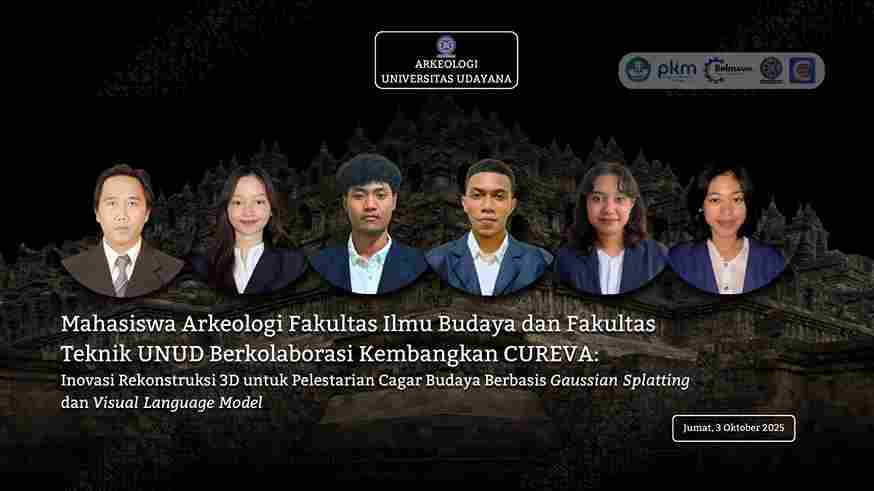
Denpasar, October 3, 2025 — Students from the Archaeology Study Program, Faculty of Cultural Sciences, Udayana University, have taken part in developing an innovative digital project titled CUREVA (Cultural Reconstruction Innovation), which successfully received funding under the Student Creativity Program in the Karsa Cipta category (PKM-KC) organized by the Directorate General of Higher Education, Ministry of Education, Science, and Technology.
Through this interdisciplinary collaboration, Archaeology students of Udayana University play an active role in developing a digital reconstruction system for cultural heritage objects using Gaussian Splatting (GS) and Visual Language Model (VLM) technologies to support the preservation of historical artifacts and sites.
Damage to cultural heritage objects remains a serious issue in Indonesia. Natural factors, human activities, and the lack of proper maintenance and supervision often lead to the loss of original form and historical value of many artifacts. This condition inspired the PKM-KC CUREVA team to create a digital solution aimed not only at reconstructing and documenting cultural heritage objects but also at educating the public on the importance of preserving Indonesia’s cultural legacy.
CUREVA Innovation: Integrating Gaussian Splatting and Visual Language Model
As part of the project, the CUREVA team designed a web application that serves as the central platform for the documentation and digital reconstruction process of cultural heritage artifacts. This platform connects the technical outputs with users, providing a space for research, education, and conservation that is efficient and accessible.
Figure 1. CUREVA Web Application
The Gaussian Splatting technique enables high-accuracy 3D reconstruction in terms of form, color, and texture. Compared to the Neural Radiance Field (NeRF) method, this approach is more efficient, offering faster rendering and direct accessibility through the web platform.
Figure 2. Development of 3D Reconstruction Technology
Figure 3. 3D Reconstruction Process Using the Gaussian Splatting Algorith
Meanwhile, the Visual Language Model (VLM) is an Artificial Intelligence (AI)–based system capable of understanding and generating both visual (image and video) and textual data. The model is trained on multimodal datasets to produce reconstructions that are contextually accurate and informative.
The Role of Archaeology Students in the CUREVA Team
Figure 5. CUREVA Team Members
The CUREVA PKM-KC team consists of five students from different academic backgrounds: Nabiel Rafa Angela Bhaswara (Mechanical Engineering) as team leader, I Putu Galih Bhramanta Yudarsana (Mechanical Engineering), Egidius Santus Dominus (Information Technology), and two Archaeology students from the Faculty of Cultural Sciences — Mouzalina Raisha Anfal and Kavita DiyaZinta Dewi. The team is supervised by Prof. I Wayan Widhiada, S.T., M.Sc., Ph.D.
The involvement of Archaeology students in this project represents a meaningful synergy between the humanities and technology. This collaboration is expected to strengthen efforts in cultural heritage preservation through digital innovation while also encouraging young generations to take part in safeguarding Indonesia’s cultural identity.
FACULTY OF HUMANITIES